
What is Diabetes?
Diabetes is not just a human condition—it affects our animal companions too. Scientists estimated that 1 in 230 cats in the US have diabetes. The World Health Organization defines diabetes as a metabolic disorder in which the body has high sugar levels for prolonged periods of time. There are two types of diabetes in cats: diabetes insipidus and diabetes mellitus. Diabetes insipidus is an extremely rare metabolic disorder that results in the body’s failure to regulate water content. The most common form of diabetes in the cat is diabetes mellitus. This disorder is most often diagnosed in cats five years of age or older, but it is possible to be seen in younger cats.
 Diabetes mellitus is a disease of the pancreas. The pancreas is a small, but vital, organ that plays a key role in digestion and hormone regulation. With diabetes, the pancreas fails to properly produce insulin, the hormone responsible for regulating glucose (sugar) levels in the blood.
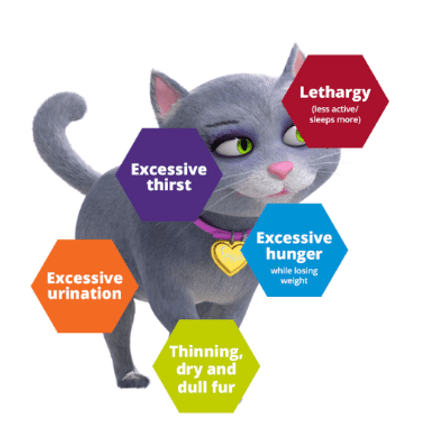
Diabetes is most common in middle-aged and senior cats. Cats that are cushinoid, obese, or have had pancreatitis are at an increased risk of developing this disease. Diabetic cats present with a variety of signs and symptoms that are unique to each pet. These include, but are not limited to, excessive thirst, excessive urination (initially), ravenous appetite, lethargy, coat deterioration. Other symptoms are reoccurring infections, weakened immune response, weight loss, etc.
How is diabetes diagnosed?
Diagnosis of diabetes is based on three criteria:
1. Clinical signs: weight loss, increased drinking, increased urination, and ravenous appetite in most pets early on in disease progression.
2. Presence of a persistently high-level glucose in the blood.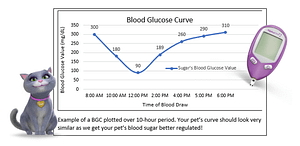
3. Presence of glucose in the urine.
How is diabetes treated?
Diabetic Diets
Diabetic diets are higher fiber diets. These diets are lower in carbohydrates (sugar) and take longer to digest, allowing for smaller and less intense blood sugar spikes throughout the day. For these diets to work optimally, they must be given EXCLUSIVELY (meaning no extra biscuits and treats). The recommended diet is Purina DM and is available in wet and dry. Diabetic cats need to be fed consistent, measured meals, twice daily, just before each insulin injection. Free feeding, where a bowl of food is always left down, is not ideal. This makes it more difficult to regulate blood sugar properly.
Insulin
The foundation for regulating blood glucose is the administration of insulin by injection. Your personal commitment to your cat’s treatment is fundamental in maintaining a well-regulated diabetic and preventing a diabetic crisis. Most diabetic cats require insulin injections twice daily and must be fed the same type and amount of food on a set 12-hour schedule (i.e.: 8am/8pm, 9:30am/9:30pm, etc.). If you are out of town, arrangements need to be made to ensure your pets treatment schedule is maintained.
What should I expect regarding monitoring my diabetic pet?
Home Monitoring
Monitoring your cat at home is an important part of treating a diabetic animal. Cats with well-controlled diabetes should maintain a normal activity level and demeanor. You should monitor daily water intake, urine production, appetite, body weight, amount of insulin administered, and blood glucose levels (if you have access to a pet glucometer at home). Monitoring is best coordinated in close collaboration with your veterinarian. If you see changes in the factors stated above, contact your veterinarian to discuss.
Monitoring of Blood
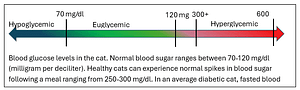 In addition to monitoring at home, your pet will need to be seen at the vet periodically for special blood tests used to monitor blood glucose levels. There are two common blood tests that veterinarians perform to assess how well regulated your diabetic pet is: 1.) Blood Glucose Curves and 2.) Fructosamine Value Checks.
1. Blood Glucose Curve
Blood Glucose Curves (BGC) are a common preliminary tool used to assess the effectiveness of your pet’s insulin. They help to determine if adjustments need to be made to the amount of insulin being given. BGC are utilized as an early assessment method as they give a very quick snapshot of how your pet is doing. They do not require your pet to be on a set insulin dose for an extended period (usually only 7 days). This allows your vet to make small, frequent changes in your pet’s insulin as we work to get your pet to a well-managed blood glucose range.
During BGC, your vet will test your pets blood glucose value several times over 6-10 hours to get a picture of the range of blood sugar levels your pet experiences over the course of the day. Under your current daily treatment regimen, a well-maintained diabetic cat should maintain blood glucose values between 100-250 mg/dl. To get an accurate picture, you should maintain at least 1 week of consistent treatment regimen, prior to your pet’s BGC.
Test Day
On the day of your pets BGC, we ask that you feed breakfast and administer your pet’s morning insulin as usual. You will then drop off your pet shortly after insulin is given at your designated admission time. Plan to be in the office for 20-25 minutes to go over diabetic admission paperwork. Your pet will be hospitalized for the day so that your veterinary care team can periodically take blood samples.
Staff members will obtain samples using a simple ear prick technique. Once the curve is complete, the doctor will call to discuss the results and any changes that need to be made to your pet’s treatment plan. Starting out, you can expect to be bringing your pet in more frequently (every few weeks) as your veterinary works hard to get your pet’s diabetes regulated. Once your pet is well regulated, you can expect to bring your pet in every 2-6 months for monitoring. The frequency of these visits will be determined by your vet and is based on each individual pet’s case.
2. Fructosamine Testing
Once your pet’s diabetes is reasonably well managed or for pets that your vet is not able to easily perform blood glucose curves, your vet may utilize a second test to monitor your pet. For this testing, your vet will send a small sample of your pet’s blood to an outside lab for an analysis of Fructosamine levels. Fructosamine is a protein molecule that binds with glucose floating in the bloodstream. Because there is a consistent ratio of Fructosamine molecules per each glucose molecule, we can accurately estimate the amount of glucose in the blood by counting the amount of Fructosamine.
Fructosamine testing is recommended for several reasons. First, due to the lifespan of Fructosamine molecules, it gives a “big picture” assessment of how well managed your pet has been over a greater period. By comparison, BGC shows a snapshot of blood sugar levels at only a single point in time. Fructosamine tests reflect the average blood sugar levels over the 2-3 weeks preceding the blood draw. Secondly, because Fructosamine testing looks at a larger period, it is not affected by individual stress points that may occur during your pets visits at the vet.
Stress can temporarily elevate sugar in the blood to provide energy for the body in the “fight or flight” response. Because of this, Fructosamine tests are viewed as more accurate than blood glucose curves affected by stress. It is important to note that Fructosamine results can be falsely elevated in pets that maintain excess fat. Lastly, Fructosamine test does not require a full day stay at the hospital as we just need to collect one small sample of blood! Like BGC, Fructosamine results help you vet assess if any changes are needed to your pet’s diabetic treatment plan.
What are complications I might experience with my diabetic pet?
Hypoglycemia
Insulin therapy lowers blood glucose, possibly to dangerously low levels called hypoglycemia. Your vet tries to prevent this by combining conservative insulin dosing, with frequent monitoring of BGC, Fructosamine tests, and clear communication with you. We want you to report your observations of your cat at home.
However, with all these preventive measures in place, you pet may still experience hypoglycemic episodes. Often these events occur as a result of human error. Here are examples: 1) A pet is given a larger dose of insulin due to miss drawing of dose. 2) A pet is given their full dose of insulin but refuses to eat her meal. 3) An owner forgets that they gave insulin and accidentally double dose. 4) When two individuals in the house both give insulin unknowing the other had already done so. To prevent these dosage errors, set a clear communication of medication and feeding schedules with all members of the household.
To prevent hypoglycemia, there are two rules to follow when giving insulin to your pet:
1. Always give insulin AFTER your pet has eaten their meal – the insulin you are administering is designed to manage the sugar that will be entering the blood as a result of the meal you are feeding. If you give the insulin injection at the same time as offering food and your pet does not eat there will be no sugar ingested and as a result the insulin will lower the blood sugar too much, putting your pet at risk of a hypoglycemic crisis.
2. When in doubt, do NOT redose – it will happen sometimes, that you will get busy and question whether you gave your pet their insulin. You’re human! However, when this happens, NEVER redose insulin. It is safer for your pet’s blood sugar to run little higher than for you to risk double dosing your pet, causing their blood sugar to bottom out into a hypoglycemic crisis. Similarly, if you inject your pet’s insulin and are not confident it went under the skin, do not redose as even if your pet did not get their full dose. It is less damaging to their blood sugar to be mildly elevated for a brief period of time than to be too low.
As the owner, it is important to be vigilant to the signs that your diabetic pet is in a hypoglycemic crisis. Most common signs of hypoglycemia include weakness, tremors, lethargy, drunken behavior, lack of coordination, and vomiting. In serious cases, pets can experience seizures and diabetic comas. Hypoglycemia can be fatal if left untreated. Quick reaction is key to keeping your pet safe. If your pet shows any signs listed above, immediately try to offer your pet his regular food as the goal is to increase your pet’s blood sugar by introducing additional carbohydrates (sugar).
If your cat does not eat voluntarily, it should be fed oral glucose in the form of honey, corn syrup, or proprietary dextrose gels (these can be bought over the counter at most pharmacies), and then brought to your veterinarian immediately. These sugars can be applied to the gums as they can be absorbed transmucosal. It is important to note, however, that you should NEVER attempt to force fingers, food, or fluids into your pets’ mouth if they are convulsing or comatose as it may result in severe injury to yourself and even aspiration and asphyxiation for your pet.
What is my diabetic pet’s prognosis?
Pets with controlled diabetes will return to normal levels of thirst, appetite, urination, and activity. Their weight will stabilize or increase appropriately, and they will be less likely to develop related complications. A small percentage of cats can even go into remission and no longer need insulin treatments. Remission is possible only in cats whose pancreas has not fully lost the ability to produce insulin. However, many of these cats require the continuation of a diabetic diet to help ensure the pancreas continues to function. Whether remission is achieved or not, your pet can continue to live a happy, healthy life with commitment to treatment and proper diabetic management.
This blog is provided compliments of Rolling Hills Animal Hospital, a full-service veterinary hospital located at 2027 Suffolk Road, Suite 7, Finksburg, Maryland 21048. For more information, call 410-857-5757, or visit Our Page here.